Thursday, May 24, 2018

Why Paraguay


The Arab League has just cut of ties with Guatemala over the latter’s decision to hand over the strings to Washington and play good by moving its embassy to Jerusalem. 

To add insult to injury, the move was made amid protests in the occupied Palestinian territories in commemoration of the 70th anniversary of the Nakba, and the subsequent shooting and killing of dozens of Palestinian protesting in the Gaza Strip. 

To add further insult, Paraguay followed suit.

The decision to enrage the international community at large and risk severing ties with Arab and Muslim nations is likely attributed to the art of cajolement. Praise Washington and Tel Aviv for their efforts to establish peace and justice, and support such rhetoric with tactless actions. In short, to stay in America’s good books, kiss up to Israel on diplomatic and economic levels.  

Jimmy Morales, Guatemala’s President, said his country was sending a message of "love, peace and fraternity" to Israel on the occasion of recognising Jerusalem as Israel’s capital. Paraguayan President Horacio Cartes praised his country´s decision at the inauguration ceremony as "A historic day that strengthens ties between Paraguay and Israel".

Since everyone is being poetic about it, so can we.

Little Morales and Cartes said one day

Let´s go out together my friend and play

However they were scared of the bully at bay

Who has never had a sensible thing to say

Plus there is his little brother Shabtai

Who is always part of every fray

So they thought of a plan to sway

And make them both happy in May

They moved their toys across the hay

And built play castles from drenched clay

We did it! echoed their shameless bray

And a star to our heads the bullies will inlay

When those Arabs come our way

We can change our minds, if they have more to pay

Tuesday, May 22, 2018

Patriotic Fallacies and Slitting Wrists


An article published in Medium on 14 May entitled '6 Things not to say to Circassians on  21 May' provokes a comeback answer to each of the 6 taboos. The author might as well have invited readers to dissect and critique each nationalism-drenched word included in the 6 bullet points. On the occasion of commemorating the Circassian genocide and exodus  - Circassian Day of Mourning  - on 21 May, a polite yet naïve request came in by a Circassian-history-revival activist in the form of do nots.  The author argued that the following statements not only infuriate fellow Circassians, but are also void of precision, morality, and empathy.

I beg to differ.

First, the 6 commandment-nots…the 6 not-to-say-phrases.   
  1. I think it’s time to get over it.
  2. 1763–1864? Isn’t that ages ago?
  3. There are other issues in the world.
  4. You should just be proud of your current citizenship/country of residence.
  5. Isn’t this too much nationalism?
  6.  How is what you are doing going to make any difference?
According to the writer, it would be a mistake to forget the genocide, whereby the perils of such an act are equated with the consequences of forgetting the Palestinian Nakba. The deportation is not that far past in history, and no, nationalism is not being accentuated by the continuous glorification of heritage.

It is hard for any observer to sympathise with the romantically-saturated rhetoric that serves little purpose, especially amidst current events in the very region where most Circassians live. To equate the injustice, infliction of suffering, and substantial ordeal of Palestinians with that of present Circassian diaspora is simply insulting. Circassian communities are well respected and integrated in each hosting nation – nations that must have become the homes of the Caucasian immigrants by now.  Not letting go of the past is exactly what has caused such injustice in Palestine, where the atrocities borne by Jews on the hands of European regimes in the 20th century continues to justify barbarities in the 21st.  Insisting on belonging to a genetic family tree instead of integrating into a community forest will not right the wrongs and will not change history. Rights will not be restored by a continuous reminder of a tragedy that must be forgotten in order to move on.

Yes, it is time to get over it. Yes, it is past history and no sentimental value could be rationally attached to a non-existing cause. And yes, there are more important issues in the world, notably one in the immediate vicinity. Belonging and allegiance to fellow citizens indeed carries more value than centuries-old ancestral ties, and yes too much nationalism is dangerous and has proven to be so. And no added-value is attached to lamenting the past and passing on memories, instead of purpose.

Keeping tradition alive is commendable and contributes to cultural richness. However, when historic preservation carries subtle racist tendencies that aim at guaranteeing membership to a club privée of the ousted and wronged, self-inflicted alienation is almost ensured.  Loving one´s nation – may it be confined to national boundaries or extended to a common past – should not be unconditional. When loving thy people comes at a high cost of prioritising race over humanity, romance over reason, tradition over virtue, and pride over empathy, it stops being love, and turns into obsession.

Too much love can kill you indeed. In fact, and in an analogy that was used perfectly by one of the most fatally attractive minds, love can become an obsession that slits wrists.


Tuesday, May 15, 2018

With Arms Wide Open

 
  The final results of Iraqi parliamentary elections are expected today. Again, the timing is perfect for reaching a consensual arrangement between political leaders over the governance of sectarian-torn Iraq. The current Prime Minister Haidar Al Abadi has received a substantial setback with his bloc´s trailing in third place after Muqtada Al Sader´s Saeroun list and Hadi Al Amiri´s Fatah list. Now, Iraq might see the formation of a government that is led by a Shiite force linked with an anti-US AND anti-Iran controversial figure. Al Sader might be positioned to rule from the back scenes and bring peace to a country that has been ruined by invented religious and ethnic divisions.

Years of rebellion have led the young cleric to reach a stage of maturity and stability in his political and ideological discourses. Once a founder of a militia that fought off the US invasion, and a close ally to Tehran´s political elite, Al Sadr had metamorphosed into a nationalist leader who opted for joining hands with secular groups - including the Iraqi Communist party - in the elections. Snubbing Iran, the young political leader has taken a new route towards Iraqi nationalism. Whether this was a political stunt to prove to the Iraqi public that he carries no Shiite-exclusive agenda or a catch all electoral strategy it remains to be seen. However, both the US and Iran will now be forced to support their proxies through their art of clandestine intervention in order to ensure that whoever gets to lead Iraq must be an ally, not a foe. In other words, anyone is fine by both camps as look as he takes sides and sidelines nationalist interests for the benefit of Iranian and American patrons. After all, the US just pulled out of the nuclear deal with Iran and will ensure that Iraq remains a battle ground in its war with Tehran. Iran´s leadership will not let the opportunity of using Iraq again in its confrontation with Washington; fangs and talons will emerge, and Iraq will curse the day it saw democracy.

A figure such Al Sader  - albeit all its controversy - might remind the Iraqis and the region at large that the years of using Arab nations as proxies for international confrontations is over. Prioritising the interests and concerns of citizens  - irrespective of their ethnicity or religious affiliation  - should be the guiding force behind forming a government in Baghdad. If Al Sader can bring peace to Iraq, then he should be received with Sader Rahib (arms wide open).   

Arab nationalism has died with the death of Saddam Hussein´s Baath (resurrection) party in Iraq; the revival of the resurrection party will require resuscitation efforts from the Iraqi people who must join breaths and hands to place their interests as a nation before any other consideration. Slogans of Arab unity and defence against external agendas might have been a rhetoric that was been murdered and buried deep...exhuming the remains of these calls does not seem such a bad idea at the moment. 

Monday, May 14, 2018

Stuck in the Middle With You*


A Saudi jpournalist published on his personal Twitter account last week an insanely provocative phrase that stated: 'If Israel attacked Iran and war erupted between the two countries, then I would support Israel mindfully and heart-fully, considering that our primary enemy is Iran and not Israel. Arabs of the north must know that'.

Three interesting words were employed by the Saudi journalist in his insightful tweet: mental, emotional, and primary. Let us start with mental and emotional capacities first before moving to the equally astute observation regarding the prioritisation of enemies.

Unlike social relations that are formed and broken upon the discretion and judgement of individuals who enjoy full liberty in managing their personal affairs, relations between nations are not. Whilst laws that regulate social relations could be manipulated to one´s own benefit based on his/her whims, laws that govern diplomatic relations are vigorously guarded to ensure the preservation of national interest. Such laws are not solely formulated in legislative forums, but have been preceded by natural laws that are have are innate in modern systems, may they be political or social.

The Saudi journalist suggested in his tweet that from a rational perspective (mindfully) and based on his sentiments (heart-fully), he would stand by Israel should a war break off between Tel Aviv (Jerusalem to the liking of the journalist) and Tehran. He justified his position on both reason and sentiment. It is the same rhetoric that has been employed across time and the perfect excuse to turn a blind eye towards the laws that govern our being, including those derived from morals, religion, history, and constitutions. In the eighteenth century Charles de Montesquieu beautifully portrayed human behaviour and how it should be reined:

Man, as a physical being, is like other bodies governed by invariable laws. As an intelligent being, he incessantly transgresses the laws established by God, and changes those of his own instituting. He is left to his private direction, though a limited being, and subject, like all finite intelligences, to ignorance and error: even his imperfect knowledge he loses; and as a sensible creature, he is hurried away by a thousand impetuous passions. Such a being might every instant forget his Creator; God has therefore reminded him of his duty by the laws of religion. Such a being is liable every moment to forget himself; philosophy has provided against this by the laws of morality. Formed to live in society, he might forget his fellow-creatures; legislators have therefore by political and civil laws confined him to his duty (The Spirit of Laws).

The impetuous passions of our fellow journalist have been heated up with regional events that include Iran´s dominance expansion with Hezbollah´s victory in Lebanese parliamentary elections, Shiite victory in Iraqi parliamentary elections, Iran´s clandestine nuclear programme that was unravelled recently by Israel, the Israeli attack on Iranian interests in Syria, and Europe´s hesitation to support the US´s withdrawal from the nuclear accords with Iran on 8 May.  To face the perils of Persian further empowerment, the journalist tossed religion, morals, and laws into the bin of ´you do not serve me at the moment´, and attempted to stir impulsive, manipulative, and self-serving emotions. Such emotions precisely contradict the journalist’s punchline in his intelligent tweet: our primary enemy is Iran, not Israel. If he is suggesting that Israel ranks second on the enemy list, why would he ´mindfully and heart-fully´ support his second enemy? Irrespective of the reader´s stance regarding the Iranian-Arab and Arab-Israeli drama, it makes little sense to support a historic enemy (to respect the journalist´s use of words and rhetoric albeit wrongfully). And why would such calculated support be ceded with both passion and reason? Importantly, how did he expect that ‘Arabs from the north´ would justify the support to Israel - the secondary threat - in a hypothetical war with Iran - the primary source of danger? In what way did he expect that reason and emotions guide the Arab nation in justifying take sides in a war between common 'enemies'? When will respect to laws be the sole guide to a nation´s affairs? Why did the journalist make no reference to the importance of respecting the cultural and historic sensitivities that have been entrenched in legislative systems of neighbouring nations, and opted for a narrow, self-serving view that he advised others to follow? Why is it that after three centuries one is still debating the dangers of emotionally-charged sentiments that come at the cost of established laws and regulations?

When emotions are high, people vent and spurt out irrational statements. When seasoned journalists take that route, politicians might likely follow suit…and no Montesquieuan remedy could help in that case. 

* To those who know what this song means to me, you are very very much missed.
    

Tuesday, May 8, 2018

Should I Stay or Should I Go?


On 12 May, American President Donald Trump will decide whether the United States will pull out of the Joint Comprehensive Plan of Action (JCPOA): the international deal with Iran over its nuclear programme.

But the United States will leave. Just Called Pour an Obvious Adieu.

The timing of the awaited decision is no coincidence. First, it will come less than a week after the Lebanese elections would have been celebrated. As has been predicted, Iran´s proxy Shiite militia in Lebanon – dubbed Lebanese political organisation, won considerable votes at the May parliamentary elections. Indeed, Hezbollah political bloc’s gains came at the expense of the Saudi backed Future Movement, which lost one-third of its seats. Naturally there was finger pointing and conspiracy theories regarding schemes to eliminate the Future party from the political process. Most likely, Sunni forces in the region will take a free ride on the Shiite-danger-blame train.  

Second, the Israeli Knesset adopted a proposal on 1 May that authorises the premier and defence minister to declare war ‘under extreme circumstances’. Concomitantly, the Israeli Prime Minister showcased Iranian nuclear documents (obtained by Mossad operatives in Iran) regarding Tehran´s naughty nuclear programme prior to the JCPOA.

Third, Palestinians and other Arab and Muslim nations will commemorate al Nakba Day (remembrance of Palestinian diaspora following the establishment of the independent state of Israel on 14 May 1948) on 14 May. In some cases, the usual chaos, mayhem, and violence will likely take place in the West Bank and the Gaza strip, with the support and blessings of Israel´s historic enemies (Iran and its proxy organisations in the Middle East).

When, and not if, the US pulls out of the nuclear deal, it will have a series of supporting arguments. Iranian associates are gaining further ground in the troubled Middle East, most recently attested by the Lebanese parliamentary elections. Iran´s retaliation against Israel for the latter´s offence against Iranian troops and military presence in Syria will not go unnoticed – although un-analysed and un-justified with objective goggles. Self-defence will be expected from the Israeli Defence Forces, whose green light will be given with the ease of switching a light bulb at home (thanks to the newly adopted proposal granting the premier and his defence minister the right to respond instantaneously when Israel is under threat). Attacks against Israelis and death chants to Zionists on al Nakba Day will stir sympathetic emotions towards Tel Aviv and a blind eye towards its actions which will likely be directed against Iranian proxies.

Pulling out of the JCPOA will not only be the sensible decision in light  of the recently exposed documents regarding Tehran´s web of nuclear lies, but also when taking into account the related geopolitical developments that have rendered Iran the biggest threat to the world at large.

Washington´s unwise decision will reverberate in the region, and more bloodshed is expected. Like a broken record, the rhetoric has paved the way for further violence, and as promised, no one should be surprised.


Tuesday, April 24, 2018

Because He Said So


On 14 May, Israel will celebrate 70 years of independence. On that day, the United States is also expected to move its embassy to Jerusalem in the spirit of celebrations amongst Israelis, and mourning of Palestinians who are reminded of the Nakba: the day they lost their land 7 decades ago.

To mark the upcoming occasion, an Israeli senior Ministry of Foreign Affairs official spoke to Al-Monitor regarding Israel’s historical narrative at 70 years of independence, indicating that Israel´s democratic existence in a region of autocratic regimes bestows further legitimacy to the imminent  festivities. Plus, Donald Trump has endorsed Israel’s right to be recognised by the Palestinians as the homeland of the Jewish people. Yes, Trump´s statement seals the deal and provides the missing and crucial conformation of the Jewishness of Israel and the Jerusalemness of its capital.

It is interesting how the official´s enlightening proclamation came right after his/her reiteration that Israel is the only democracy in the region. In that official´s opinion, democracy constitutes what millions of Arabs believe is fair, what the Palestinian people conceive as historical injustice inflicted upon them, and the  illegal, unilateral recognition of the status of Jerusalem as Israel’s capital in spite of international condemnation. Trump said it should be Israel´s capital, then it should be. Let us forget the city´s history that stretches back to 5000 BC, its linkages with the patriarch of the Hebrews Abraham and Moises, the early wars over the city between the Israelis and Philistines, the rulings of David and Solomon, and the eras of the Persians, Macedonians, Maccabees, Romans and Herodes. Christianity’s birth and Byzantiu´s rule are irrelevant, and so is the city´s fruition under the Umayyads, Abbasids, Fatimids and Ayubbis. The Crusaders´ battles are the past and must be ignored. The Ottoman´s Empire, the two World Wars, and the British mandate should all be forgotten. The rich history of the city, the coexistence of multiple religions over centuries, and the dozens of civilisations that reigned over it mean nothing to some Israeli aides. Trump´s recognition suffices.

In three weeks´ time people of the sacred land will be rejoicing and mourning simultaneously. The world will be watching silently until action is deemed necessary. The euphoria of masked peace and unfair conquer of the holy city should not be a reason to forget history and the lessons that should have been learned and entrenched in both hearts and minds.  Independence day should be an occasion to remember the history of Jerusalem and the right that Muslims, Christians, and Jews have in that land. Trump´s words should not trump history.

Friday, February 23, 2018

Shelters Before Graves


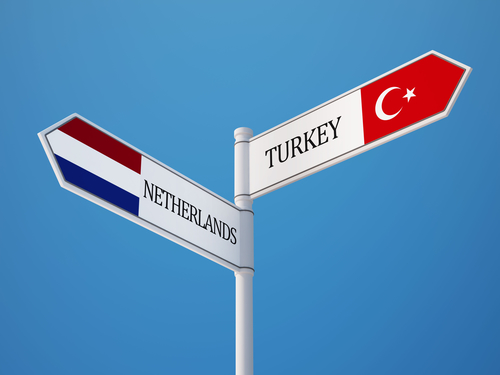
Resultado de imagen de netherlands and turkey

Inspite of seeing her making out passionately with another man at the staircase, he decided to ignore the issue, but confront – and prosecute – her for the affair she had 10 years ago. I was advised* to start off with a sexy tone to lure readers into skimming through…I hope that was sexy enough, albeilt the unappealing context of this article.  Now, the hot affair is a perfect analogy for what has happened between The Netherlands and Turkey following the famous Armenian genocide recognition vote.

On 22 February, the lower house of the Dutch Parliament approved a motion that recognises the Armenian genocide of 1915 by the Ottoman Empire. According to Christin Union parliamentarian Joel Voordewind, The Netherlands ¨cannot deny history out of fear of sanctions. Our country houses the capital of international law after all, so we must not be afraid to do the right thing here too".  "We are acknowledging history", he said. Turkey obviously was livid, and explained that the Ottomans at the time acted within the context of a raging confrontation with Russia during World War One. In a clever answer, Turkey’s Foreign Ministry indicted that “The baseless decisions taken by the parliament of a country that turned a blind eye to a genocide — whose pain still has not eased — in Srebrenica, in the middle of Europe, have no legal binding or validity´´.

The question of why, the basis, and purpose of the vote will not be addressed by this article. However, the timing will be. As I am typing, Syria's besieged Eastern Ghouta region is being bombarded. Intense shelling has already killed over 400 people since Sunday evening, with 79 children among the dead. One must wonder whether this is not yet another genocide that must be given priority in international condemnation. What happened to Armenians over 100 years ago is not to be ignored or belittled, but those people have perished, and so have the governments that orchestrated their deaths. Nothing can be done to right the wrongs. Historic recognition is admirable, but has no value other than sentimental.

Perhaps parliamentarians across the world should not wait for another 100 years to cry over the unjust death of the innocent and helpless. There is still a chance to save Syrians and Yeminis and Afghanis and Iraqis from a plethora of genocide-associated-acts that are committed on a daily basis.

International recognition of the Armenian genocide came after years of documentation, research, lobbying, and persistence – all of which are commendable. No one should deny the tragedy of killing 1.5 million Armenians…but the death of 79 children is also tragic, and unjust. Only it is a contemporary type of injustice that is politically charged and historically blurred. The facts have not settled in, but people are settled in their graves.

The Netherlands, and many other countries, have acted like the wronged husband. He had every reason to confront his wife with regard to the affair she had 10 years ago, but should have prioritised the more recent, pressing, and not-totally-substantiated fully fledged affair. Doing the latter could save the marriage, while the former would not…it would only document an act of the past. The Netherlands, and the international community at large, should consider doing the same.

The relations between The Netherlands and Turkey are currently lukewarm, and the estranged NATO members have both withdrawn their diplomatic representation following another earlier dispute. Amidst present circumstances and heightened political conditions, it would be advised that these two important partners try to mend relations and look at the bigger picture. Now is not the time to recriminate one another for past mistakes committed by previous leaderships. More pressing issues are at stake, and reconciliation is necessary.

In the spirit of love and sexiness as recommended above, ELO´s song (One Step at a Time) has insights for those in rocky relations, including nations. 

*You know who you are, and how dear you are.

Yesterday condemned, today embraced

Donald Trump announced on May 13th 2025 that he plans to lift sanctions imposed on Syria since 2004, by virtue of Executive Order 13338, upg...